How to Translate Your Restaurant Menu for Tourists
How to translate your restaurant menu for tourists: which languages to pick, which dish names to keep, AI vs a translator, and how to show translations on a QR menu.
On this page
- Why translate your restaurant menu for tourists?
- Which languages should you translate your menu into?
- How to translate a restaurant menu, step by step
- Should you translate dish names or keep the original?
- Is AI good enough to translate a restaurant menu?
- Printed bilingual menu or a translated QR menu?
- Does a translated menu still need the local language?
- What are the most common menu translation mistakes?
- Frequently asked questions about translating a restaurant menu
- Give every guest a menu in their own language
To translate a restaurant menu for tourists, pick the two or three languages your foreign guests actually speak, keep local dish names and add a short explanation in each language, translate allergens and ingredients exactly, and have a native speaker check the result before it goes live. A digital QR menu makes this easier, because each guest can switch to their own language on their phone and you can fix a translation without reprinting. This guide shows you how to translate your restaurant menu step by step, which dish names to keep, and when AI is good enough.
Short answer: start from a clean, final menu in your own language; choose languages from your real guest data, usually English first; keep signature dish names in the original and explain them in a line (“Penne all’arrabbiata – pasta in a spicy tomato and chilli sauce”); translate ingredients and the 14 allergens word for word; use AI or a translation tool for the first draft, then have a native speaker review it; and publish it on a menu where guests choose the language themselves. Keep prices, numbers and the dish order identical in every language.
Why translate your restaurant menu for tourists?
You translate your menu because a guest who cannot read it orders less, asks more questions and is more likely to order something they don’t enjoy or, worse, something they are allergic to. The audience is large: UN Tourism counted an estimated 1.52 billion international tourist arrivals in 2025, 793 million of them in Europe (UN Tourism via Hospitality Net). The mix is changing too: nights spent in EU tourist accommodation by visitors from Asia rose 15.4% in 2025, according to Eurostat figures reported by The Brussels Times.
A good translation also saves your staff time. When the menu explains what “vitello tonnato” or “bitterballen” is, servers stop explaining the same dish twenty times a night and can take orders faster.
Which languages should you translate your menu into?
Translate your menu into the languages your own foreign guests speak, starting with English, which most international visitors can read even when it is not their first language. Don’t guess; look at the data you already have:
- Your bookings. Reservation tools and hotel partners often show guests’ countries or languages.
- Your reviews. Count the languages of your last 100 reviews on Google and TripAdvisor.
- Your staff. Ask servers which languages they hear every day and which tables need the most help.
- Your local tourist office. Regional tourism statistics list visitors by country of origin.
For most venues two or three languages cover nearly every table. A trattoria in Florence might choose English, German and French; a beach bar in Antalya English, German and Russian; a café in Amsterdam English and German. Add a language only when you can keep it up to date, because a half-translated menu looks worse than none.
How to translate a restaurant menu, step by step
You translate a restaurant menu by finalising the original, building a short glossary, translating dish by dish with descriptions and allergens, and checking the result with a native speaker before guests see it.
1. Finish the original menu first
Fix prices, dish names and descriptions in your own language before translating anything. Every change after translation has to be made three or four times, so settle the menu first; if you are still adjusting prices, our guide on how to price menu items helps.
2. Write a short description for every dish
Tourists need what a local already knows: the main ingredients and how the dish is cooked. “Cacio e pepe” means nothing to most visitors; “spaghetti with pecorino cheese and black pepper” does. Write one plain line per dish in your own language, then translate that line.
3. Build a glossary of your recurring words
List the terms that appear again and again: cooking methods (grilled, braised, fried), cuts of meat, local cheeses, sizes and side dishes. Decide one translation for each and use it everywhere, so “alla griglia” is always “grilled” and never “on the grill” on one page and “barbecued” on the next.
4. Decide which dish names to keep
Keep the original name for signature and regional dishes and add the explanation underneath; translate generic items such as “mixed salad” or “chicken soup”. The next section shows how to decide.
5. Translate allergens and ingredients exactly
This is the one part where creativity is not allowed. Translate each allergen by its exact name (wheat, walnut, celery) and never shorten “pistachio” to “nuts”. Our guide to the 14 allergens on a menu lists them all.
6. Get a first draft from AI or a translator
For a draft, a modern AI translation tool is fast and usually good on plain descriptions. Give it context (“this is an Italian restaurant menu; keep dish names in Italian; translate descriptions into natural English”) and paste your glossary.
7. Have a native speaker check it
Ask a native speaker, a regular guest, a staff member or a freelance translator to read the whole menu once. They catch the literal mistakes that make menus famous on social media, like “penne all’arrabbiata” turned into “pens to the angry one”, one of the examples collected by Dissapore.
8. Keep every language in sync
When a dish changes, change it in all languages the same day. Make it part of the routine: whoever updates the menu also updates the translations, or the dish stays off until they do.
Should you translate dish names or keep the original?
Keep the original name for signature, regional and well-known dishes and explain them in a line, and translate names only for generic dishes where the original adds nothing. Tourists often come for local food, and the original name helps them find the dish they read about; consistency matters too, so if you keep a name in one language, keep it in all of them, as translation agency Blarlo advises.
| Type of dish | What to do | Example (English menu) |
|---|---|---|
| Famous dish known abroad | Keep the name, no explanation needed | Pizza Margherita, Wiener Schnitzel, Paella |
| Regional or signature dish | Keep the name and add a one-line description | Vitello tonnato – thin sliced veal with a creamy tuna and caper sauce |
| Generic dish | Translate the name | Insalata mista → Mixed salad |
| Creative or pun name | Keep it and describe what’s on the plate | “Nonna’s Sunday” – slow-cooked beef ragù with fresh tagliatelle |
| Local ingredient with no equivalent | Keep the word and explain it once | ‘Nduja – soft, spicy Calabrian pork sausage |
Is AI good enough to translate a restaurant menu?
AI is good enough for a first draft of a restaurant menu, but not for the final version without a human check, because it still mistranslates local dish names, idioms and cuts of meat. The best workflow for a small restaurant combines them: AI for speed, a native speaker for the last read.
| Method | Speed | Quality | Cost | Best for |
|---|---|---|---|---|
| Guests’ phone camera translation | Instant | Low on dish names; you don’t control it | Free for you | Nothing; it’s what happens when you don’t translate |
| Free machine translation | Minutes | Literal; frequent errors on dish names | Free | Rough drafts only |
| AI with context and a glossary | Minutes | Good on descriptions; check names and allergens | Free to low | First draft for most menus |
| AI plus native-speaker review | Hours to a day | High | Low | Most independent restaurants |
| Professional translator | Days | Highest; best for wine lists and fine dining | Highest | Fine dining, hotel groups, long wine lists |
Printed bilingual menu or a translated QR menu?
A translated QR menu is better than a printed bilingual menu once you need more than two languages, because each guest sees one clean menu in their own language and changes cost nothing to publish. A printed menu with two languages side by side still works for a short menu and a single main foreign language.
| Printed bilingual menu | Separate printed menus per language | Translated QR menu | |
|---|---|---|---|
| Languages that fit | 2 | As many as you print | Several, chosen by the guest |
| Readability | Cluttered on long menus | Clean | Clean, on the guest’s own phone |
| Updating a dish | Reprint | Reprint every version | Edit once per language, live at once |
| Risk of outdated versions | Medium | High (the English copy is always last year’s) | Low |
| Works without a phone | Yes | Yes | No: keep a few printed copies |
This is where Elegant Menu, the QR menu and ordering platform, fits the job. You add the languages you want, translate dish names and descriptions, and guests pick their own language on the menu after scanning the QR code. You can type each translation yourself, or ask the Elegant Menu menu assistant to translate new dishes and then review its suggestions before approving them. Allergen labels sit on every dish, so they travel with the translation. Translations are part of the paid plans: 1 translation language on Basic (€7/month billed yearly) and 8 languages on Standard (€23.17/month billed yearly). The setup steps are in how to add multiple languages to your menu.
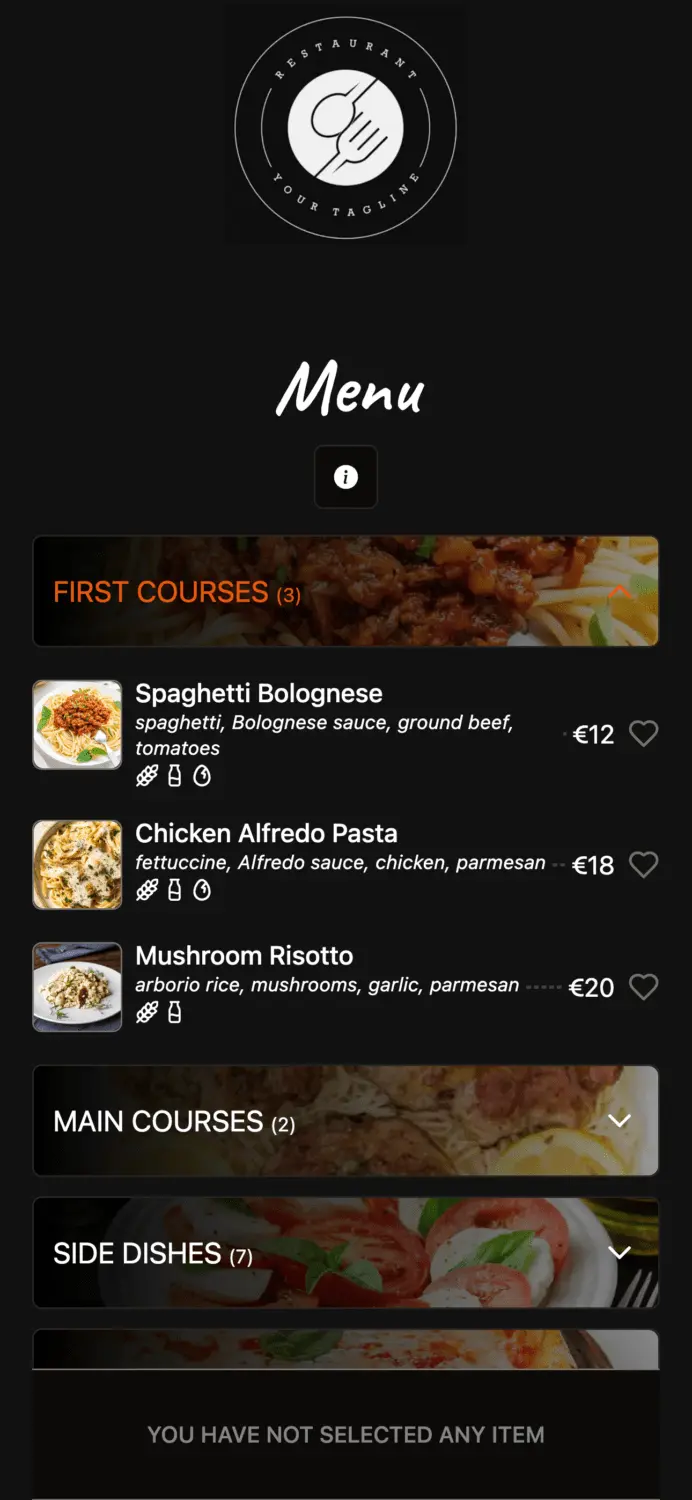
If you don’t have a QR menu yet, start with our guide on how to make a QR code menu, or compare tools, including their translation features, in the best QR menu platforms in 2026.
Does a translated menu still need the local language?
Yes: in the EU, mandatory food information such as allergens must appear in a language easily understood by consumers in the country where the food is sold, so translations are added to the local language, not used instead of it. Article 15 of Regulation (EU) No 1169/2011 sets this rule, lets each member state require one or more of its official languages, and allows the same information in several languages. In practice: keep your menu complete in the local language, and treat every other language as an extra layer for visitors. Check your national food authority for the details; this is practical guidance, not legal advice.
What are the most common menu translation mistakes?
The most common menu translation mistakes are literal word-for-word translations, inconsistent terms and translations that fall out of date.
- Translating names word for word. “Alla” becomes “to the”, and your dish becomes a joke. Keep the name and describe the dish instead.
- Vague allergens. “Nuts” is not enough when the dish contains walnuts; name the nut.
- Different prices or dishes per language. The English menu still shows last season’s dishes or old prices. Keep one source and translate from it.
- Converting prices. Show your prices in your own currency in every language; a converted price is out of date the next day.
- Too many languages. Eight half-finished translations help nobody. Do two well, then add more.
- Forgetting the extras. Drinks, sides, daily specials, the service-charge line and the allergen notice need translating too.
Frequently asked questions about translating a restaurant menu
How many languages should a restaurant menu have?
Most restaurants need the local language plus two or three others, chosen from their own guest data. English comes first almost everywhere, followed by the languages of your largest visitor groups.
Can I use Google Translate or ChatGPT for my menu?
You can use machine translation or AI for a first draft, but have a native speaker check the final menu. Machine tools handle plain descriptions well and still get local dish names, idioms and cuts of meat wrong.
Should I translate the names of local dishes?
Usually not: keep the original name for regional and signature dishes and add a one-line description in the guest’s language. Translate only generic items such as salads, soups and sides.
Do allergens have to be translated?
In the EU, allergen information must be in a language local consumers easily understand; translating it for tourists is not required but strongly advisable, because visitors with allergies need it most. Translate each allergen by its exact name.
What is the easiest way to offer a menu in several languages?
The easiest way is a digital QR menu with built-in translations, where guests choose their language after scanning and you update every language from one place. Elegant Menu offers 1 translation language on Basic and 8 on Standard.
Give every guest a menu in their own language
Build your menu for free with Elegant Menu, add translations when you’re ready, and let tourists switch to their own language with one tap. See how a live menu looks on a guest’s phone first.