How to Price Menu Items: the Food Cost Formula, With Examples
How to price menu items with the food cost formula: cost each dish, pick a target food cost %, add VAT and round. Worked examples in euros for pizza, steak and more.
On this page
- What is the food cost formula for menu pricing?
- What food cost percentage should a restaurant aim for?
- How to price menu items in 6 steps
- What should the price range be across your menu?
- Is food cost percentage or cash margin more important?
- How do you check your actual food cost?
- How often should you update menu prices?
- Common menu pricing mistakes to avoid
- FAQ: pricing menu items
- Update your prices in seconds, not reprints
To learn how to price menu items, start with one formula: menu price = cost of one portion ÷ target food cost percentage. Cost every ingredient on the plate, divide by the share of the price you want food to take (usually 28–35%), then add VAT and round to a clean number. The rest of this guide shows each step with worked examples in euros.
Short answer: A dish whose ingredients cost €3.00, priced at a 30% food cost target, needs a net price of €10.00 (€3.00 ÷ 0.30). Add your country’s VAT, for example 10% in Italy, to get €11.00 on the menu. Then check the cash margin, compare with nearby restaurants and review prices every few months.
What is the food cost formula for menu pricing?
The food cost formula says the menu price before VAT equals the ingredient cost of one portion divided by your target food cost percentage. Food cost percentage is the share of a dish’s selling price spent on its ingredients. Lightspeed puts it as “cost of ingredients ÷ food sales × 100” and turns it around for pricing: divide a dish’s ingredient cost by your target percentage to get the price (Lightspeed).
You can also think of it as a multiplier. A 30% target means multiplying the plate cost by 3.33; a 25% target means multiplying by 4. Both give the same answer, and the multiplier is quicker to use with a calculator in the kitchen.
- Food cost % = plate cost ÷ net menu price × 100
- Net menu price = plate cost ÷ target food cost %
- Multiplier = 100 ÷ target food cost % (30% → 3.33)
- Menu price = net menu price × (1 + VAT rate), then rounded
What food cost percentage should a restaurant aim for?
Most restaurants aim for a food cost of roughly 28–35% of the net selling price. Lightspeed says “most UK restaurants aim for a food cost of 28–35%” (Lightspeed), Resy cites US Foods for an average of 28–32% for full-service and limited-service restaurants (Resy), and Johnson & Wales University cites Restaurant365 for 28–35% in profitable restaurants (JWU).
Treat the range as a starting point, not a rule. A pizzeria with cheap flour and tomatoes can run lower; a steakhouse often accepts a higher percentage because one steak still earns more cash than one pizza. What matters is that your overall mix, plus labour and rent, leaves a profit.
How to price menu items in 6 steps
Pricing a dish takes six steps: cost the recipe, correct for yield, choose a target, calculate the net price, add VAT and round, then sanity-check the result.
Step 1: Write a recipe card and cost every ingredient
List every ingredient in one portion with its weight, then multiply by the price you actually pay per kilo or litre (from your latest supplier invoice, not last year’s). Include the small things: oil, garnish, bread, sauces, and packaging for takeaway. Here is an example recipe card for a Margherita pizza (illustrative prices):
| Ingredient | Quantity | Purchase price | Cost per portion |
|---|---|---|---|
| Pizza dough | 250 g | €1.00/kg | €0.25 |
| Tomato sauce | 80 g | €2.40/kg | €0.19 |
| Fior di latte mozzarella | 120 g | €9.00/kg | €1.08 |
| Basil and olive oil | — | — | €0.12 |
| Plate cost | €1.64 |
Step 2: Correct for yield and trim loss
Use the cost of the usable part of an ingredient, not the price on the invoice. If you buy beef tenderloin at €38.00/kg and only 75% is usable after trimming, the real cost is €38.00 ÷ 0.75 = €50.67/kg. A 180 g steak then costs €9.12, not the €6.84 you would get from the invoice price. Skipping this step is the most common reason a dish looks profitable on paper and isn’t.
Step 3: Choose a target food cost percentage
Pick a target per category rather than one number for the whole menu. Low-cost dishes like pizza, pasta and soups can carry a lower percentage; premium proteins usually need a higher one so the price stays believable. The table below shows how the target changes the price of the €1.64 pizza:
| Target food cost | Multiplier | Net price | Price incl. 10% VAT |
|---|---|---|---|
| 25% | 4.00 | €6.56 | €7.22 |
| 28% | 3.57 | €5.86 | €6.44 |
| 30% | 3.33 | €5.47 | €6.01 |
| 35% | 2.86 | €4.69 | €5.15 |
Step 4: Calculate the net price
Divide the plate cost by the target. For the pizza at a 25% target: €1.64 ÷ 0.25 = €6.56 net. For a steak plate (€9.12 tenderloin + €1.40 sides + €0.48 sauce = €11.00) at a 35% target: €11.00 ÷ 0.35 = €31.43 net.
Step 5: Add VAT and round to a clean price
Menu prices for guests in Europe include VAT, so multiply the net price by your VAT rate and round up to a tidy number. The pizza in Italy (10% VAT): €6.56 × 1.10 = €7.22, rounded to €7.50. The steak in Germany (7% on food since 2026): €31.43 × 1.07 = €33.63, rounded to €34.00.
VAT on restaurant food differs by country and sometimes between eating in and taking away, so check your own rate:
- Italy: 10% on food and drink served in restaurants (Informazione Fiscale).
- Germany: 7% on food permanently from 1 January 2026; drinks stay at 19% (IHK Frankfurt).
- Netherlands: 9% on meals and non-alcoholic drinks, 21% on alcohol (MKB Servicedesk).
- Norway: 25% on food served on the premises, 15% on takeaway food (Skatteetaten).
One trap: always calculate food cost on the price without VAT. €1.64 ÷ €7.50 looks like 21.9%, but the real figure is €1.64 ÷ €6.82 (the €7.50 price minus 10% VAT) = 24.0%. The higher the VAT rate, the bigger the error.
Step 6: Sanity-check against the market and your cash margin
Before you print or publish a price, compare it with similar dishes nearby. Resy suggests reviewing 5 to 10 comparable restaurants and noting their lowest, highest and average prices (Resy). If your formula price is far above the local range, look at portion size or a cheaper ingredient before you accept a lower margin.
What should the price range be across your menu?
Within one section of the menu (starters, mains, pizzas, desserts), the most expensive dish should usually cost about two to three times the cheapest, with small steps in between. Hotel pricing consultant Cayuga Hospitality suggests that in sections of six or more items the highest price is at least twice the lowest, and that the gap between neighbouring prices stays under about 20%, so guests feel comfortable trading up (Hospitality Net). The Omnès principles used in menu engineering set the ceiling: in a long section, the highest price shouldn’t be more than 2.5 to 3 times the lowest, or guests struggle to place your restaurant’s price level (Koust).
Example: if your cheapest pizza is the €7.50 Margherita, a pizza section priced €7.50, €8.50, €9.50, €11.00, €12.50, €14.00 and €16.00 works well. The top price is 2.1 times the bottom one, and no step is bigger than 16%. A €24 pizza in the same list would look out of place; put it in a specials box or rethink the portion instead.
Two more habits help: list dishes from lowest to highest price inside each section, and avoid giving every dessert or starter the same price, so guests on any budget find something that fits.
Is food cost percentage or cash margin more important?
Cash margin (contribution margin) pays your bills, so use it alongside food cost percentage rather than chasing the lowest percentage. Contribution margin is the net price minus the plate cost. In our examples:
| Dish | Menu price | Net price | Plate cost | Food cost % | Cash margin |
|---|---|---|---|---|---|
| Margherita pizza (IT, 10% VAT) | €7.50 | €6.82 | €1.64 | 24.0% | €5.18 |
| Beef tenderloin (DE, 7% VAT) | €34.00 | €31.78 | €11.00 | 34.6% | €20.78 |
The steak has the “worse” percentage but earns four times more cash per plate. That’s why a single target for every dish misleads: balance low-percentage items with high-margin ones, and steer guests towards the dishes that earn the most. Our guide to increasing restaurant sales with a digital menu covers how placement and photos help.
How do you check your actual food cost?
Your actual food cost is (opening stock + purchases − closing stock) ÷ net food sales, measured over a week or a month. Compare it with the “ideal” food cost from your recipe cards; the gap shows waste, over-portioning, price rises you missed or stock going missing.
Example: opening stock €8,000 + purchases €12,500 − closing stock €7,700 = €12,800 used. Divided by €40,000 net food sales, that is 32%. If your recipe cards predict 29%, the 3-point gap is worth €1,200 a month. Find it before you raise prices.
How often should you update menu prices?
Re-cost your menu whenever a key supplier price changes and review all prices at least every few months. Resy notes that the National Restaurant Association recommends frequent small increases, for example several 3% steps instead of one 15% jump in a year (Resy). Small steps are easier on regulars, and they keep your food cost from drifting.
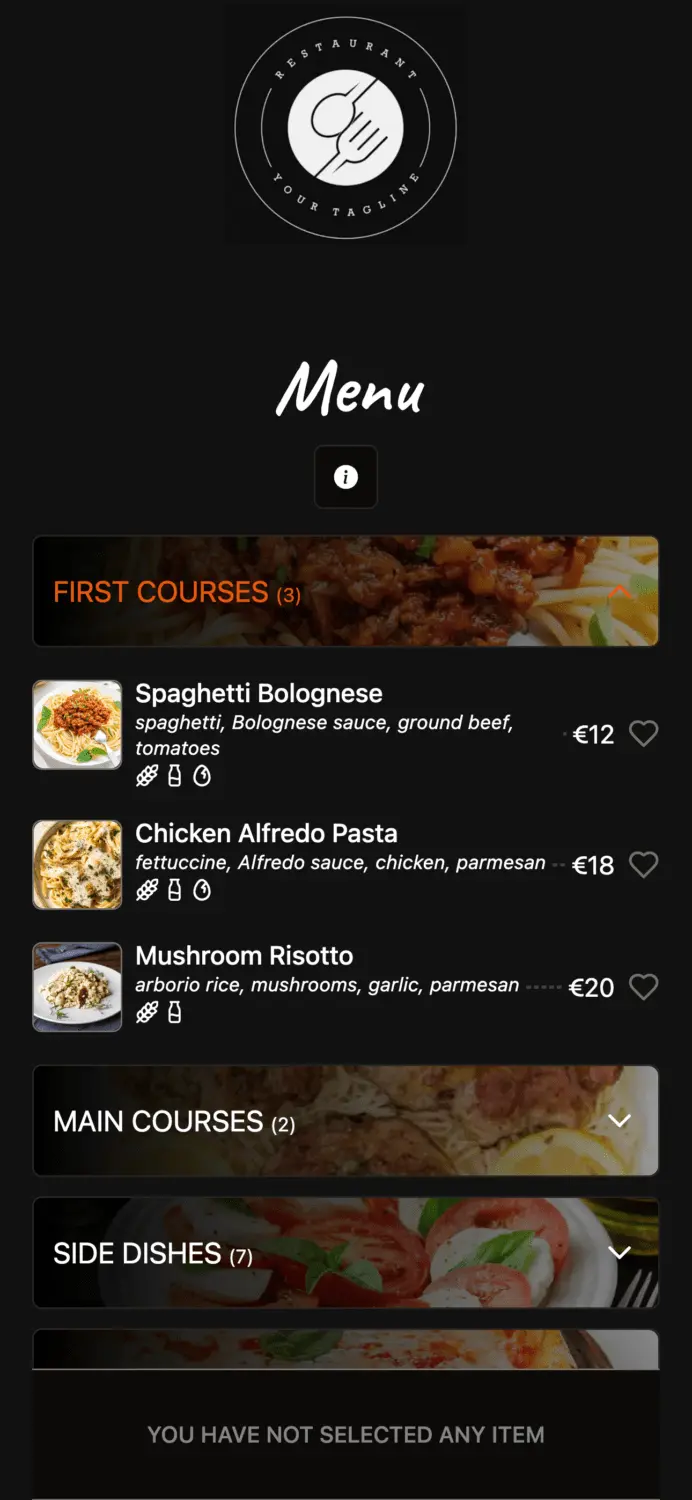
The practical barrier is reprinting. With a printed menu, every change costs money, so owners put it off. A QR menu removes that: with Elegant Menu, the QR menu and ordering platform, you change a price online and every guest who scans sees it straight away, with nothing to reprint. You can also hide a dish when an ingredient gets too expensive or runs out, and on paid plans the order analytics show which items actually sell. The free plan covers 6 categories with 15 items each; if you don’t have a QR menu yet, here is how to make a QR code menu in about 15 minutes.
Common menu pricing mistakes to avoid
Most pricing mistakes come from costing too little of the plate or forgetting tax.
- Using invoice prices without yield. Trim, bones, peel and cooking loss all raise the true cost.
- Calculating on the VAT-inclusive price. It flatters your food cost by the VAT rate.
- Forgetting the extras. Free bread, dressings, garnishes and takeaway boxes belong in the plate cost.
- One target for everything. Judge each dish on both percentage and cash margin.
- Pricing once and never again. Recipe cards go stale as soon as supplier prices move.
Clear menus also help guests trust your prices. Listing allergens properly is part of that; see our guide to food allergen requirements on menus. If many of your guests are tourists, a menu in several languages makes them less likely to skip dishes they can’t read.
FAQ: pricing menu items
How do I price a dish on my restaurant menu?
Use the formula menu price before VAT = plate cost ÷ target food cost percentage. A €4.00 plate cost at a 30% target gives €13.33 net; add VAT, round to a clean number and check it against similar dishes nearby.
How do you cost a plate of food?
Weigh every ingredient in one portion, multiply each by what you pay per kilo or litre after trim and cooking loss, and add the extras such as oil, garnish and bread. The total is the plate cost.
What is a good food cost percentage?
Around 28–35% of the net price is the common benchmark, with lower figures for pizza and pasta and higher figures for premium meat and fish.
What should the price range be across my menu?
Within each section, keep the highest price between about two and three times the lowest, with steps of no more than about 20% between neighbouring dishes.
Should I calculate food cost with or without VAT?
Always without VAT, because the VAT goes to the tax office, not to you. Calculate the net price first, then add VAT for the menu.
How do I price drinks?
Use the same formula with a separate, usually lower, target percentage for drinks, and remember that drinks often carry a different VAT rate than food. Our guide on how to price drinks works through examples.
How often should I change menu prices?
Re-cost when supplier prices change and review the whole menu every few months; small, regular increases are easier on guests than one big jump.
Update your prices in seconds, not reprints
Once your dishes are costed, put the prices on a menu you can change any time. Elegant Menu is free to start, with allergen labels on every dish and ordering from the table when you’re ready.