How to Price Drinks: the Pour Cost Formula for Cocktails, Wine and Beer
How to price drinks with the pour cost formula: cost each pour, pick a target %, add VAT and round. Euro examples for a spritz, a negroni, wine by the glass and draught beer.
On this page
- What is the pour cost formula for pricing drinks?
- What pour cost percentage should a bar aim for?
- How to price drinks in 5 steps
- How do you price wine by the glass and by the bottle?
- How do you price draught beer from a keg?
- Do drinks have a different VAT rate than food?
- Is pour cost percentage or cash margin more important?
- How do you check your real pour cost?
- Common drink pricing mistakes
- FAQ: how to price drinks
- Put your new drink prices live today
To learn how to price drinks, start with one formula: drink price before VAT = cost of the pour ÷ target pour cost percentage. Cost every millilitre that goes into the glass, divide by the share of the price you want the drink itself to take (often 18–25%), then add VAT and round. This guide runs that formula through cocktails, wine by the glass and by the bottle, draught beer and coffee, with worked examples in euros that work in any country.
Short answer: A spritz whose ingredients cost €1.69, priced at a 25% pour cost target, needs a net price of €6.76 (€1.69 ÷ 0.25). Add Italy’s 10% VAT on drinks served at the table and you get €7.44, rounded to €7.50 on the menu. Spirits usually take a lower target than wine and beer, so set one target per category and check the cash each drink earns, not only the percentage.
What is the pour cost formula for pricing drinks?
The pour cost formula says a drink’s price before VAT equals the cost of its ingredients divided by your target pour cost percentage. Pour cost is the drinks version of food cost: the share of a drink’s net selling price spent on what goes into the glass. BevSpot writes it as “Price = Cost of Ingredients / Target Pour Cost” (BevSpot). It is the same logic as our food cost formula for pricing menu items, just with lower targets.
- Pour cost % = ingredient cost of one drink ÷ net selling price × 100
- Net drink price = ingredient cost ÷ target pour cost %
- Multiplier = 100 ÷ target pour cost % (20% → 5, 25% → 4)
- Cost per ml = bottle or keg price ÷ usable millilitres
- Menu price = net price × (1 + VAT rate), then rounded
What pour cost percentage should a bar aim for?
Most bars aim for an overall beverage cost of about 18–24% of net drink sales, with spirits lower and wine and beer higher. The published benchmarks differ a little, so treat them as a range:
| Source | Spirits / liquor | Wine | Beer | All drinks |
|---|---|---|---|---|
| BevSpot | 14% | 22% | 20% | — |
| Backbar | — | — | — | 18–24% |
| Restroworks | 18–24% (nightclubs 15–18%, fine dining 20–24%) | — | — | — |
| Qamarero | 18–24% | often 25–30% | often 25–30% | — |
Why would you sit above or below the range? A nightclub selling vodka-mixers at volume can run a low pour cost. A wine bar with a deep list, or a restaurant whose drinks mainly go with food, usually runs higher, because guests compare wine prices with the shop and won’t pay five times retail. Where alcohol duty is high, as in Norway, where Norway’s public health institute simply says “Alkohol er dyrt i Norge” (FHI), purchase prices are higher and you may have to accept a higher percentage to keep prices believable. All these benchmarks come from US and international sources and are calculated on prices without sales tax, so compare them with your net prices, not the VAT-inclusive menu price.
How to price drinks in 5 steps
Pricing a drink takes five steps: work out the cost per millilitre, cost the recipe, choose a target per category, calculate the net price, then add VAT and round.
Step 1: Work out the cost per millilitre
Divide what you pay for each bottle (net of VAT, from your latest invoice) by its volume. A 0.7 L bottle of gin at €22.00 costs €22.00 ÷ 700 = €0.031 per ml; a 1 L bottle of Campari at €16.00 costs €0.016 per ml. If your team free-pours rather than using a jigger, real pours run bigger than the recipe, so either measure or add an allowance for it.
Step 2: Cost the recipe, garnish and ice included
Write a spec card for every drink with the exact pour of each ingredient, then multiply by the cost per ml. Include garnish, ice, syrups and soda; they add up. Two examples (illustrative prices):
| Drink | Ingredient | Pour | Purchase price | Cost |
|---|---|---|---|---|
| Spritz | Aperitivo bitter | 60 ml | €14.00 / 1 L | €0.84 |
| Prosecco | 90 ml | €6.00 / 0.75 L | €0.72 | |
| Soda, orange slice, ice | 30 ml + garnish | — | €0.13 | |
| Pour cost | €1.69 | |||
| Negroni | Gin | 30 ml | €22.00 / 0.7 L | €0.94 |
| Campari | 30 ml | €16.00 / 1 L | €0.48 | |
| Red vermouth | 30 ml | €12.00 / 1 L | €0.36 | |
| Orange peel, ice | — | — | €0.12 | |
| Pour cost | €1.90 |
Step 3: Choose a target per category
Set separate targets for spirits and cocktails, wine, beer and soft drinks rather than one number for the bar. The table shows how the target changes the price of the €1.69 spritz:
| Target pour cost | Multiplier | Net price | Price incl. 10% VAT |
|---|---|---|---|
| 18% | 5.56 | €9.39 | €10.33 |
| 20% | 5.00 | €8.45 | €9.30 |
| 25% | 4.00 | €6.76 | €7.44 |
| 30% | 3.33 | €5.63 | €6.20 |
Step 4: Calculate the net price
Divide the pour cost by the target. The spritz at 25%: €1.69 ÷ 0.25 = €6.76 net. The negroni at 20%: €1.90 ÷ 0.20 = €9.50 net.
Step 5: Add VAT and round to a clean price
Multiply the net price by your drinks VAT rate and round to a tidy number. The spritz in Italy (10%): €6.76 × 1.10 = €7.44, rounded to €7.50. The negroni in Germany (19% on drinks): €9.50 × 1.19 = €11.31, rounded to €11.50. Rounding changes the percentage slightly, so re-check it: €11.50 ÷ 1.19 = €9.66 net, and €1.90 ÷ €9.66 = 19.7%.
How do you price wine by the glass and by the bottle?
Price wine by the glass so the first glass roughly pays for the whole bottle, and price bottles at a lower multiplier, usually around 2.5–3 times cost. Qamarero advises bars to “aim to recoup the bottle cost in the first glass” and puts bottle markups at 2.5–3× wholesale, falling to 2–2.5× for premium wines (Qamarero). The glass carries the higher margin because an opened bottle can go off before you finish it.
Example (illustrative): a bottle that costs you €6.00 net gives five 150 ml glasses, so each glass costs €1.20. Pricing the glass at the bottle cost gives €6.00 net, a 20% pour cost; in the Netherlands, where alcohol carries 21% VAT, that is €7.26, rounded to €7.50. The same bottle at 3× is €18.00 net, or €21.78 with VAT, rounded to €22.00:
| Bottle cost (net) | Glass cost (150 ml) | Glass price net (first glass = bottle) | Bottle at 3× net | Bottle at 2.5× net |
|---|---|---|---|---|
| €6.00 | €1.20 | €6.00 | €18.00 | €15.00 |
| €10.00 | €2.00 | €10.00 | €30.00 | €25.00 |
| €20.00 | €4.00 | €20.00 | €60.00 | €50.00 |
Notice the last row: a €20.00 glass is hard to sell. For better bottles, many venues accept a higher pour cost on the glass, or sell those wines only by the bottle, so the cash margin stays high while the price stays believable.
How do you price draught beer from a keg?
Divide the keg price by the number of glasses you actually sell from it after line loss, then apply your beer target. Foam, line cleaning and the first pours of a new keg all lose beer; Qamarero says a standard US keg yields about 115–120 usable pints after waste, slightly below its full volume (Qamarero). Measure your own loss by comparing keg volume with glasses rung up.
Example (illustrative): a 30 L keg costs €90.00 net. At 0.4 L per glass that is 75 glasses in theory; with 7% loss you sell about 69, so each glass costs €90.00 ÷ 69 = €1.30. At a 25% target (Qamarero’s 4× draught markup) the net price is €5.20; with Germany’s 19% VAT on drinks that is €6.19, rounded to €6.20. Bottled beer is simpler: a 0.33 L bottle that costs €0.90 at a 3–4× markup sells for €2.70–3.60 net.
Do drinks have a different VAT rate than food?
In many European countries, yes: alcohol, and sometimes all drinks, carry a higher VAT rate than food, and takeaway can differ from drinks served on the premises. Check your own rate before you price:
- Italy: 10% on drinks served on the premises, generally 22% when sold to take away, such as a bottle of wine (Stripe).
- Germany: 19% on all drinks in restaurants, while food served there is at 7% from 2026 (IHK Frankfurt).
- Netherlands: 9% on meals and non-alcoholic drinks, 21% on alcoholic drinks (MKB Servicedesk).
- Norway: 25% on food and drink served on the premises; alcoholic drinks never qualify for the 15% food rate (Skatteetaten).
- Turkey: 10% KDV on restaurant and café service, 20% on the alcoholic drinks part of it (Edenred Türkiye).
Always calculate pour cost on the net price. A €7.50 Dutch glass of wine looks like a 16% pour cost (€1.20 ÷ €7.50), but the real figure is €1.20 ÷ €6.20 = 19.4%. At 21% VAT the error is bigger than on food.
Is pour cost percentage or cash margin more important?
Cash margin pays the rent, so judge each drink on both: the percentage keeps costs in check, the cash shows what a sale is worth. Here are the examples above side by side, plus an espresso (7 g of coffee at €20/kg plus sugar, about €0.17; illustrative):
| Drink | Menu price | Net price | Pour cost | Pour cost % | Cash margin |
|---|---|---|---|---|---|
| Espresso (IT, 10%) | €1.30 | €1.18 | €0.17 | 14.4% | €1.01 |
| Draught beer 0.4 L (DE, 19%) | €6.20 | €5.21 | €1.30 | 25.0% | €3.91 |
| Glass of wine (NL, 21%) | €7.50 | €6.20 | €1.20 | 19.4% | €5.00 |
| Spritz (IT, 10%) | €7.50 | €6.82 | €1.69 | 24.8% | €5.13 |
| Negroni (DE, 19%) | €11.50 | €9.66 | €1.90 | 19.7% | €7.76 |
| Bottle of wine (NL, 21%) | €22.00 | €18.18 | €6.00 | 33.0% | €12.18 |
The espresso has the best percentage and the smallest cash; the bottle of wine has the worst percentage and the most cash. That’s why a table that orders a bottle is worth more than its pour cost suggests. Premium bottles follow the same logic; our bottle service menu guide shows how clubs price them as packages.
How do you check your real pour cost?
Your actual pour cost is (opening stock + purchases − closing stock) ÷ net drink sales, counted weekly or monthly. BevSpot defines pour cost as “Inventory Usage / Sales” and notes that “industry shrinkage hovers around 20%” (BevSpot), so expect your real figure to sit above what your spec cards predict.
Example (illustrative): opening stock €4,000 + purchases €6,500 − closing stock €3,900 = €6,600 used. Divided by €30,000 net drink sales, that is 22%. If your spec cards predict 19%, the 3-point gap is worth €900 a month. Count spirits by category (or by bottle for expensive ones) so you can see where the gap comes from: over-pouring, spillage, free drinks or a supplier price you missed. Fix those before you touch prices.
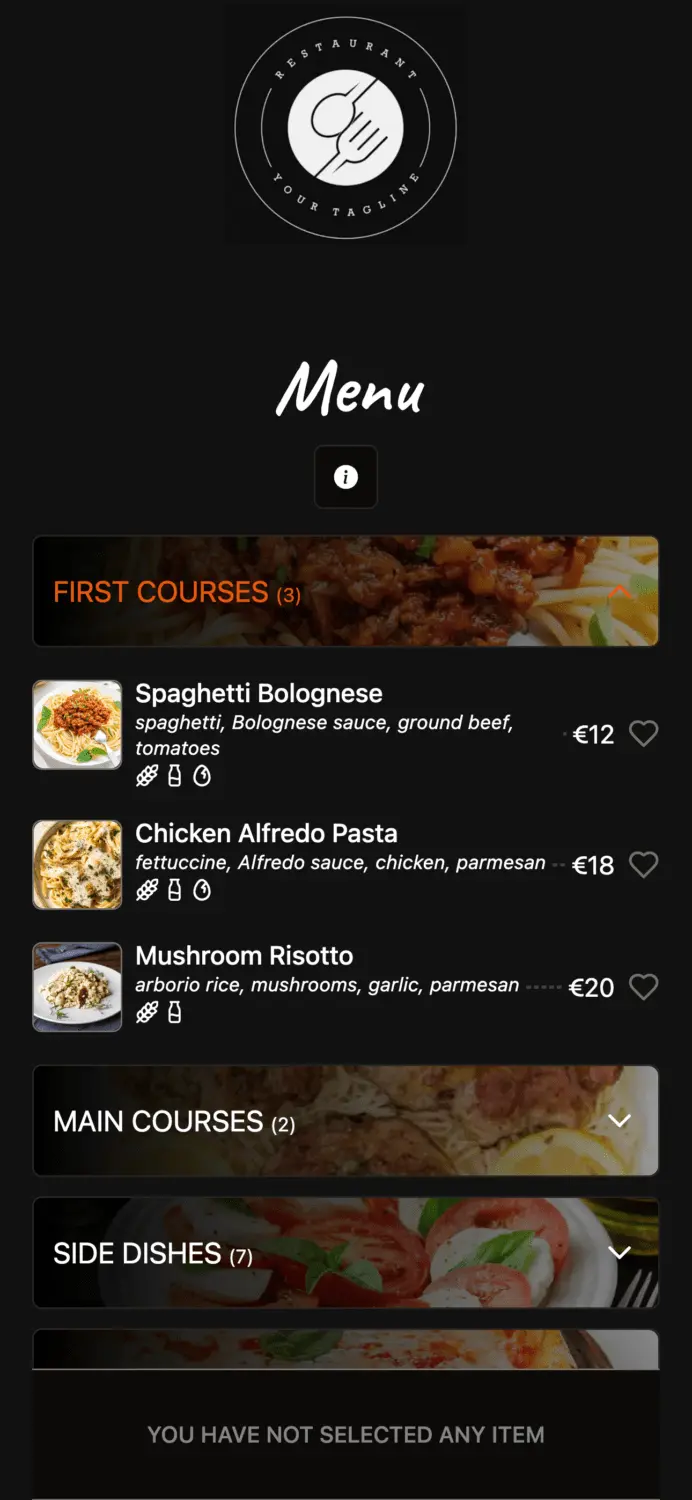
When the numbers do call for new prices, the hard part is often the menu itself. With Elegant Menu, the QR menu and ordering platform, you change a drink’s price online and guests see it at the next scan. The built-in menu assistant takes plain instructions such as “raise all cocktails by €0.50” and shows each change for one-tap approval, on every plan, and on paid plans the order analytics show which drinks actually sell.
Common drink pricing mistakes
Most drink pricing mistakes come from costing the recipe instead of the real pour.
- Pricing on the VAT-inclusive price. With 19–25% VAT on drinks, it flatters your pour cost by several points.
- Ignoring free-pouring and line loss. Specs say 40 ml; the glass gets 50. Kegs never yield their full volume.
- Forgetting garnish, ice, syrups and mixers. They are small per drink and large per month.
- Pricing wine by the glass at the bottle multiplier. The glass needs to cover what you pour away when a bottle goes off.
- One target for the whole bar. Spirits, wine, beer and coffee have different costs and different price expectations.
If your bar serves many visitors, a drinks list they can read helps too; see how to translate your restaurant menu for tourists.
FAQ: how to price drinks
What is the formula for pricing drinks?
Net drink price = ingredient cost ÷ target pour cost percentage. A cocktail costing €2.00 at a 20% target sells for €10.00 before VAT; add VAT and round.
What is a good pour cost percentage?
Around 18–24% for all drinks together is the common benchmark, with spirits often lower and wine and beer often higher.
How much should a glass of wine cost compared with the bottle?
A common rule is that the first glass covers what you paid for the bottle, so a €6.00 bottle gives a €6.00 net glass, while the full bottle sells at about 2.5–3 times cost.
How many drinks do you get from a bottle of spirits?
A 0.7 L bottle gives 17 full 4 cl measures and a 1 L bottle gives 25, before any spillage; divide the bottle price by that number to get the cost per measure.
Should drink prices include VAT?
Menu prices for guests in Europe include VAT, but you should calculate pour cost and margins on the net price, because the VAT goes to the tax office.
Put your new drink prices live today
Once your drinks are costed, show the prices on a menu you can change any time. Elegant Menu is free to start, and ordering from the table is there when you’re ready. If you haven’t set one up yet, here’s how to make a QR code menu.