Bottle Service Menu: How to Create and Price One
How to create a bottle service menu and price it: what to list, a bottle pricing formula with euro examples, table minimum spend, packages and QR table ordering.

On this page
- What is a bottle service menu?
- What should a bottle service menu include?
- How do you price a bottle service menu?
- How do you set a minimum spend for bottle service tables?
- How should you structure bottle service packages?
- How to create a bottle service menu, step by step
- What are the most common bottle service menu mistakes?
- Frequently asked questions about bottle service menus
- Create your bottle service menu today
A bottle service menu lists the full bottles, packages and mixers a table can order, with clear prices, the table’s minimum spend and the house rules. To create one, group your bottles by spirit, price each bottle from its cost with a target cost percentage, bundle mixers into the price, and set a minimum spend per table that changes with the night. This guide walks you through each step with euro examples you can copy.
Short answer: list 10–20 bottles in three tiers (standard, premium, prestige), show the bottle size and what is included (mixers, ice, garnish) on every line, price each bottle so its cost is about 15–25% of the price before VAT, then round to a clean number. Add two or three packages, state the minimum spend per table and night, and put the menu behind a QR code on each table so guests can order another bottle without waiting for a host.
What is a bottle service menu?
A bottle service menu is the price list for reserved tables in a nightclub, lounge or bar, where guests buy full bottles of spirits or champagne, served with mixers by a dedicated host, instead of ordering drinks at the bar. Guests usually commit to a minimum spend to hold the table, and the bottle menu is what they spend it on.
Venues sell it in two ways: preset packages (a set number of bottles at a fixed price) or a minimum-spend model where the table orders freely until it reaches the minimum, as SpotOn describes. Most venues use both: packages for birthdays and groups who want a simple price, and the bottle list for everyone else.
What should a bottle service menu include?
A bottle service menu should include every bottle with its size and price, what comes with it, the packages, the minimum spend and the rules a guest needs before ordering. Use this checklist:
- Bottles grouped by category. Vodka, gin, tequila, rum, whisky, champagne and sparkling wine, plus a few non-alcoholic options. Three to five bottles per category is enough for most venues.
- Size on every line. 70 cl, 75 cl, magnum (1.5 l) and larger formats. Guests compare by size, and so do you when you price.
- What is included. For example “includes 4 mixers, ice and garnish”. Typical mixers are soda, tonic, cola, cranberry and orange juice and energy drinks (Lightspeed).
- Extra mixers and add-ons. Extra mixer jug, energy drink, fruit platter, sparkler presentation, birthday announcement.
- Packages. Two or three bundles with a fixed price and a guest count.
- Minimum spend and deposit. Per table type and per night, and whether the deposit counts toward the minimum.
- Service charge, VAT and payment. Say whether prices include VAT and service, and how the table pays.
- Allergens. Champagne and wine contain sulphites, cream liqueurs contain milk, and some liqueurs contain nuts. In the EU these are among the 14 allergens you must be able to declare; see our guide to food allergen requirements on menus.
- House rules. Minimum age, ID check, who pours, and that staff may stop service to intoxicated guests.
How do you price a bottle service menu?
Price each bottle by dividing its total cost (bottle plus included mixers and garnish) by a target cost percentage, then add VAT and round to a clean number. It is the same logic as the food cost formula in our guide on how to price menu items, applied to a whole bottle instead of a plate.
1. Work out the full cost of each bottle
Take your purchase price before VAT and add what goes to the table with the bottle: mixers, ice, fruit and the sparkler if it is included. A 70 cl vodka bought at €16 with four mixers and garnish worth €6 costs you €22.
2. Pick a target cost percentage
For spirits by the glass, bars run a median pour cost of 15%, against 24% for beer and 28% for wine, according to BevSpot’s customer data. Bottle service is usually priced in a similar band, around 15–25% cost, because the table gets a host, a reserved space and the presentation. Use a lower percentage (a higher multiplier) on entry-level bottles and a higher percentage on prestige bottles, so their prices stay believable.
3. Divide, add VAT and round
Price before VAT = full cost ÷ target cost %. Then add your VAT rate and round to the nearest €5. Here is the calculation for five bottles, with 21% VAT as an example (use your own country’s rate):
| Bottle | Bottle cost | Mixers & garnish | Target cost % | Price before VAT | Menu price (21% VAT, rounded) |
|---|---|---|---|---|---|
| Vodka 70 cl | €16 | €6 | 20% | €110 | €135 |
| Gin 70 cl | €20 | €6 | 20% | €130 | €160 |
| Premium tequila 70 cl | €35 | €6 | 22% | €186 | €225 |
| Champagne 75 cl | €28 | €2 (ice bucket) | 25% | €120 | €145 |
| Vodka magnum 1.5 l | €32 | €10 | 20% | €210 | €255 |
4. Check against the market and your bar prices
Compare your prices with two or three venues in your area, and check the bottle against your bar: a 70 cl bottle gives about 17 measures of 4 cl. If a vodka-tonic costs €10 at the bar, 17 drinks are €170, so a €135 bottle with mixers feels like fair value for a group, while the host and the table justify a premium over bar-by-the-glass economics. Big-city venues charge far more; Lightspeed reports markups of 500% to as much as 5,000% in the hottest club scenes (source). Price for your crowd, not for Las Vegas.
How do you set a minimum spend for bottle service tables?
Set the minimum spend per table by multiplying the table’s capacity by what you want each guest to spend on that night, then adjust for the table’s location and the day of the week. A simple method:
- Start from capacity. An 8-person booth on a Saturday, with a target of €50 per guest, gives €400.
- Adjust for location. Tables next to the DJ booth or stage earn a premium; tables at the edge earn less.
- Adjust for the night. Weekdays and early hours can run at 50–60% of the Saturday minimum. Special events and holidays go higher.
- Make it reachable with the menu. A €400 minimum should be two or three bottles from your list, not 2.4 bottles plus an awkward top-up.
- Take a deposit that counts toward the minimum. It protects you from no-shows without feeling like an extra fee.
For reference, Lightspeed puts the average US minimum at $500–1,500 for a group of about 10, and suggests $150–250 for casual venues (Lightspeed). Whatever you choose, print it on the menu and in the booking confirmation, so nobody discovers it at the end of the night.
How should you structure bottle service packages?
Structure two or three packages by group size and occasion, each with a fixed price, a guest count and a clear list of what is included. Packages make the decision easy for birthdays and groups, and they let you bundle add-ons with a higher margin than bottles.
| Package | Guests | What is included | Example price |
|---|---|---|---|
| Starter | Up to 4 | 1 bottle of vodka or gin (70 cl), 4 mixers, ice and garnish | €150 |
| Celebration | Up to 8 | 2 bottles of spirits, 1 champagne, 8 mixers, sparkler presentation, fruit platter | €420 |
| VIP | Up to 12 | 1 magnum, 2 bottles of spirits, 2 champagne, unlimited mixers, best-located table | €800 |
How to create a bottle service menu, step by step
You can create a digital bottle service menu in an evening: list your bottles and packages, write clear lines, add allergens and rules, then put a QR code on every table so guests order straight from their phones.
1. Choose the bottles you can always deliver
Start from your sales data and stock: which bottles sell, which ones you can reorder fast, and which prestige bottles you keep for show. A shorter list you always have in stock beats a long list with five sold-out lines.
2. Order the menu the way guests decide
Put packages first, then categories (champagne, vodka, gin, tequila, rum, whisky), then extra mixers and add-ons, then the minimum spend and rules. Within each category, list bottles from entry level to prestige, with large formats at the end.
3. Write one clear line per bottle
Each line needs the name, size, price and what is included, for example: “Premium tequila, 70 cl, includes 4 mixers, ice and lime, €225”. Add a photo of the bottle; on a dark phone screen in a club, a photo is easier to read than text.
4. Put the menu on every table with a QR code
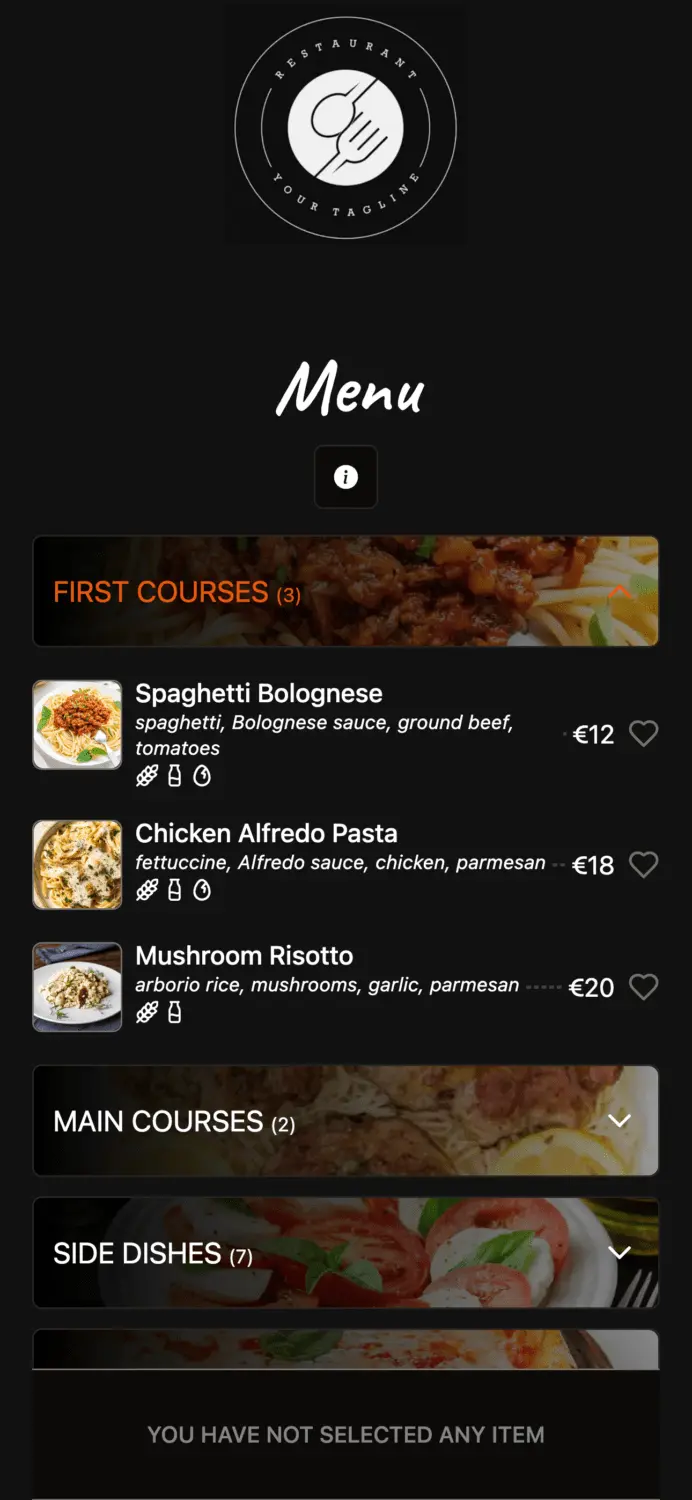
A QR code on each table lets the group order the second and third bottle without flagging down a host in a loud room. In Elegant Menu, the QR menu and ordering platform, guests scan the code at their table or booth, add a note such as “cranberry and Red Bull as mixers”, and the order lands on a live order board with the table number, where staff move it from pending to preparing to ready. Each guest gets an order-status page that updates in real time. If you’re new to QR menus, our guide on how to make a QR code menu covers printing and placement.
5. Make sure the right people see every order
Table hosts move around, so the order alert has to follow them. Elegant Menu sends order updates to Telegram for 2 users on the Standard plan and up to 7 users on Premium, and it can print tickets automatically at the bar on Standard and above. A screen behind the bar showing the order board works too.
6. Keep prices and stock current from your phone
When a bottle runs out, mark it unavailable so nobody orders it. Change prices for special nights or early-bird hours, and use a news bar at the top of the menu (on Elegant Menu Standard and above) to announce tonight’s DJ or a package offer.
7. Decide how tables pay
Either guests pay online as they order, or the host keeps a tab and settles at the end. Online payment from the menu is available from the Elegant Menu Basic plan (2% fee, 1.5% on Premium); see how to set up payments. Table reservations and deposits stay in your booking system.
8. Translate it for tourists
In holiday destinations, many of your best tables are booked by visitors. A menu they can switch to their own language removes guesswork about sizes and what is included. Elegant Menu offers 1 translation language on Basic and 8 on Standard; read how to add multiple languages to your menu.
What are the most common bottle service menu mistakes?
The most common bottle service menu mistakes are hidden costs, missing sizes and a menu that only the host can show.
- No size on the line. “Vodka €135” invites a dispute when a 70 cl bottle arrives and the guest expected a litre.
- Surprise service charges. If service or VAT is added on top, say so on the menu, not on the bill.
- Unclear mixers. State how many mixers are included and what extra ones cost.
- One flat markup for every bottle. The same multiplier makes cheap bottles look cheap and prestige bottles look absurd. Tier your cost percentages.
- Paper menus that never change. Sold-out bottles stay listed and prices go stale. A digital menu updates in seconds.
- Forgetting responsible service. Guests often pour for themselves, so staff and security need to watch for intoxication, as WebstaurantStore notes.
Frequently asked questions about bottle service menus
How much should a bottle cost on a bottle service menu?
A common approach is to price the bottle so its cost, including mixers, is 15–25% of the price before VAT. A vodka costing €22 with mixers sells for about €110 before VAT at 20%, or €135 with 21% VAT, rounded.
What is included in bottle service?
Bottle service usually includes a reserved table, a full bottle of spirits or champagne, mixers, ice and garnish, and a host who serves the table. Many venues also include glassware, a sparkler presentation for celebrations and priority entry.
Should a bottle service menu show a minimum spend?
Yes, show the minimum spend per table type and per night on the menu and in the booking confirmation. Guests accept a minimum they knew about; they dispute one they discover at the end.
How many bottles should a bottle service menu have?
Ten to twenty bottles across five or six categories, plus two or three packages, is enough for most clubs and lounges. Only list bottles you can keep in stock all night.
Can guests order bottle service from a QR code?
Yes, guests can scan a QR code on the table, choose a bottle and mixers and send the order with their table number. Staff see it on an order board, a printed ticket or a phone alert, and bring it to the table.
Create your bottle service menu today
You can build a bottle service menu with photos, sizes, allergens and table ordering for free with Elegant Menu, then add order alerts, payments and translations as your nights get busier. See how a live menu looks on a guest’s phone first.