Labor Cost Percentage: How Many Staff Can You Afford?
How to work out labor cost percentage with employer costs included, how many staff you can afford from expected covers, and what is normal. Euro examples.
On this page
- What is labor cost percentage?
- Worked example: labor cost percentage with and without employer costs
- How many staff can you afford? Work it out from expected covers
- What does an employee really cost in Europe?
- What is a normal labor cost percentage for a restaurant?
- How to lower labor cost without cutting service
- How do you check your real labour cost number?
- Common labor cost percentage mistakes
- FAQ: labor cost percentage
- Make every staff hour count
Your labor cost percentage is total labour cost (gross wages + employer costs) ÷ net sales × 100. To find how many staff you can afford, turn it around: multiply the sales you expect by your target labour percentage, and divide by what one hour of staff really costs you, including social security, holiday pay and pension. This guide shows both calculations with euro examples, what labour cost is normal, and how employer costs differ across Europe.
Short answer: a trattoria expects €12,000 of net sales next week (without VAT) and aims for a 30% labour cost. Its labour budget is €12,000 × 30% = €3,600. A cook paid €15.50 an hour gross costs about €20 an hour once employer costs of roughly 29% are added (illustrative). €3,600 ÷ €20 = 180 paid hours, or about 4.5 full-time staff on 40-hour weeks. Every hour on the rota beyond that comes out of profit.
- Total labour cost = gross wages + employer social security + holiday pay and extra monthly salaries + pension + agency and freelance staff
- Labor cost % = total labour cost ÷ net sales × 100
- Loaded hourly cost = gross hourly wage × (1 + employer cost %)
- Labour budget = expected net sales × target labour %
- Affordable hours = labour budget ÷ average loaded hourly cost
- Prime cost % = (food and drink cost + total labour cost) ÷ net sales × 100
What is labor cost percentage?
Labor cost percentage is the share of your net sales that goes on paying the people who work in the business, counted at their full cost to you, not just the wage on their payslip. It sits next to food cost as the second big number you control week to week: food cost tells you whether the kitchen uses ingredients well (see food cost percentage), labour cost tells you whether the rota fits the trade you actually do.
Two rules make the number comparable. Divide by sales without VAT, because VAT is not your money. And count the whole cost of staff: gross wages for kitchen, floor and bar, the employer’s social security contributions, holiday pay, any extra monthly salaries your country or collective agreement requires, employer pension contributions, and agency or freelance staff. If you pay yourself a salary, include it; if you don’t, remember that your margin includes your own unpaid hours.
Worked example: labor cost percentage with and without employer costs
Leaving out employer costs makes labour look several points cheaper than it is. An illustrative month for a café-bistro in Germany: €50,000 of net sales and €14,000 of gross wages. Based on the 2026 contribution rates published by health insurer TK, the employer’s share of social insurance is about 21% of gross pay (pension 9.3%, unemployment 1.3%, health 7.3% plus half of the average 2.9% additional contribution, long-term care 1.8%; our calculation from TK’s rates).
| Line | Amount | % of net sales |
|---|---|---|
| Net sales (without VAT) | €50,000 | 100% |
| Gross wages | €14,000 | 28.0% |
| + Employer social insurance (≈21.15%) | €2,961 | 5.9% |
| = Total labour cost | €16,961 | 33.9% |
On gross wages alone the café would think it runs at 28%, comfortably “normal”. The real figure is 33.9%. TK also lists the U1 (2.1% standard), U2 (0.44%) and insolvency (0.15%) levies for 2026, and other items can apply, so ask your payroll provider for the full employer cost per employee and use that.
How many staff can you afford? Work it out from expected covers
The number of staff you can afford for a shift is the shift’s expected net sales × your target labour percentage, divided by the average loaded cost of one staff hour. Build it shift by shift, because a quiet Tuesday lunch and a full Saturday dinner need very different rotas.
Step 1: Forecast covers for the shift
Start from the same shift over the last four weeks in your till or reservation system, then adjust for bookings, weather, holidays and local events. Write the forecast down, so you can compare it with what actually happened.
Step 2: Turn covers into net sales
Multiply covers by your average spend per guest without VAT. If the average bill per guest is €32 including 10% VAT (as for restaurant food in Italy), the net spend is €32 ÷ 1.10 = €29.09.
Step 3: Set the labour budget
Multiply net sales by your target labour percentage. Use a target that comes from your own monthly figures and the ranges further down, not a number from another type of venue.
Step 4: Convert the budget into hours by role
Divide by the loaded hourly cost of each role and build the rota until the budget is used. Fixed roles come first (someone has to open the kitchen and run the pass), then add servers according to the covers each of your servers can handle well; measure that number in your own room rather than borrowing one.
An illustrative Saturday dinner for a 70-seat restaurant: 140 covers × €29.09 = €4,073 net sales. At a 30% target the labour budget is €1,222. The owner has measured that each server looks after about 35 covers well on a Saturday, so four servers.
| Role | People × hours | Loaded cost per hour | Cost |
|---|---|---|---|
| Head cook | 1 × 9 h | €24 | €216 |
| Cooks | 2 × 7 h | €19 | €266 |
| Dishwasher | 1 × 7 h | €16 | €112 |
| Servers (140 covers ÷ 35) | 4 × 6 h | €17 | €408 |
| Bartender | 1 × 7 h | €17 | €119 |
| Total | 61 h | €1,121 |
€1,121 ÷ €4,073 = 27.5%, inside the €1,222 budget, with about €100 left for a cover if someone calls in sick. Now see how the affordable hours change when only the forecast changes (same €29.09 net spend, 30% target, €19 average loaded hourly cost):
| Covers forecast | Net sales | Labour budget (30%) | Affordable hours |
|---|---|---|---|
| 80 | €2,327 | €698 | 37 h |
| 110 | €3,200 | €960 | 51 h |
| 140 | €4,073 | €1,222 | 64 h |
| 170 | €4,945 | €1,484 | 78 h |
Some hours can’t shrink with the covers: with 80 guests you still need a cook on the line and someone on the floor. That’s why quiet shifts usually run at a higher labour percentage than busy ones, and why the weekly or monthly total is the number to judge. The same logic works for a whole week, as in the short answer:
| Target labour % | Weekly budget on €12,000 net sales | Paid hours at €20 | Full-time staff (40 h) |
|---|---|---|---|
| 28% | €3,360 | 168 h | 4.2 |
| 30% | €3,600 | 180 h | 4.5 |
| 32% | €3,840 | 192 h | 4.8 |
| 35% | €4,200 | 210 h | 5.3 |
What does an employee really cost in Europe?
An employee costs you their gross wage plus employer contributions and benefits that, in the countries below, add from under a fifth to around half on top, depending on the country and on what you include (our rough reading of the sources in the table). The main items, checked in November 2026 (rates change every year, so confirm them with your payroll provider):
| Country | Employer contributions | Holiday pay, extra months, pension | Wage floor |
|---|---|---|---|
| Italy | Employer INPS contributions average about 30–33% of gross pay (money.it, indicative) | 13th and 14th month salary under the hospitality collective agreement CCNL Turismo – Pubblici Esercizi (ilccnl.it); severance fund TFR of about 6.91% of pay (Coverflex) | Minimum pay set by the collective agreement |
| Germany | About 21% social insurance (our calculation from TK 2026 rates), plus levies | No statutory extra month found | €13.90 gross per hour from 1 January 2026 (Bundesregierung) |
| Netherlands | About 17% for a small employer on permanent contracts (our calculation from the 2026 premiums published by Rendement); the unemployment premium is 7.74% instead of 2.74% for flexible contracts | Holiday allowance of at least 8% of gross annual pay (Rijksoverheid); hospitality pension, employer pays half (KHN) | €14.71 per hour from 1 January 2026 (AWVN), €14.99 from 1 July 2026, aged 21+ (AWVN) |
| Norway | Employer’s National Insurance 14.1% in zone I, lower in other zones (Skatteetaten) | Holiday pay 10.2%, or 12% with five weeks’ holiday (Virke); mandatory occupational pension of at least 2% (DNB) | Generally applicable hospitality tariff; check Arbeidstilsynet for the current rate |
| Turkey | SGK employer share 21.75%, 19.75% after the 2-point discount for non-manufacturing businesses, plus 2% unemployment insurance (EY Türkiye) | Bonus (ikramiye) is not required by the Labour Act; it comes from contracts or practice (Hukuki Haber) | 33,030 TL gross per month in 2026 (EY Türkiye) |
Two practical points follow. First, in Italy the 13th and 14th month mean that twelve monthly payslips understate the year’s wages, so set aside two-twelfths every month or your summer and December labour cost will jump. Second, holiday pay in the Netherlands and Norway is a percentage of the year’s pay; if yours is paid out in one go, accrue it every month too. To get your own loaded hourly cost, divide last year’s total employer cost per role (from your payroll provider) by the hours actually worked.
What is a normal labor cost percentage for a restaurant?
A normal labor cost percentage for a restaurant is roughly 25–35% of net sales, with full-service and fine dining at the top of that range and some German sources going up to 40%. What the sources say:
- 7shifts: “Full-service restaurants typically run labor costs between 30% and 35% of revenue”; consistently below 28% may mean you are understaffed.
- KitchenNmbrs (Netherlands): hospitality labour typically 25–35% of revenue, with the kitchen alone at roughly 15–20%.
- Epos Now, citing a BDO scorecard: 25–35% for most restaurants, from 28.8% for fast casual to 34% for casual dining.
- G wie Gastro (Germany): personnel costs make up 30–40% of sales in many hospitality businesses, and food plus personnel should not stay above 65% of net sales.
Your figure can sit above the range and still work if your food cost is low (a pizzeria, a café) so that prime cost stays in line, or if your prices are high enough to pay for more service. It can sit below and still be a problem if the owner works every shift unpaid, or if service is suffering. Judge labour together with food cost: prime cost is the number that has to fit, and how it feeds into the bottom line is covered in restaurant profit margin.
How to lower labor cost without cutting service
Lower labour cost by matching hours to the trade you actually do, not by cutting pay or running every shift short. The biggest savings usually sit in a few shifts: compare labour cost and net sales per shift for a month and look at the worst five first. Stagger start and finish times so people arrive as the room fills; send one person home early when the forecast was too high; cross-train so a bartender can run food on a quiet night.
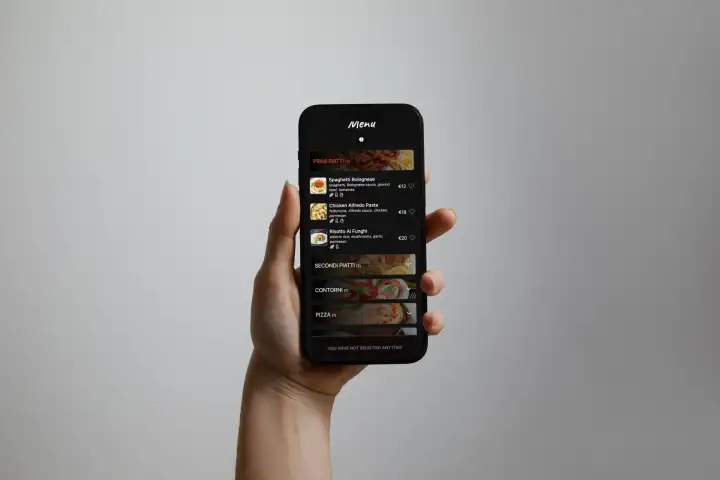
Look at the tasks, too. Taking orders, repeating them to the kitchen and running card machines to the table all take server time. With Elegant Menu, the QR menu and ordering platform, guests can order from the menu on their phone and, on paid plans, pay online; orders arrive on a live order board, and on the Standard plan receipts print automatically. Whether that lets you cover more tables per server is something to measure in your own room over a few weeks, using the per-shift comparison above.
If the hours are already tight and labour is still too high, the problem is sales or prices, not the rota. Check your prices with the food cost formula for menu pricing: a price that only covers ingredients leaves nothing to pay the people who cook and serve the dish.
How do you check your real labour cost number?
Your labour cost number is right when it matches your payroll provider’s employer-cost report for the same period, divided by net sales from your till. Check it in three ways:
- Weekly from the rota: hours worked × loaded hourly cost, divided by net sales for the week. Quick, and good enough to steer.
- Monthly from payroll: the total employer cost on your payroll report plus agency invoices, plus one-twelfth of yearly items (extra months, holiday pay, bonuses). This is the number to compare with benchmarks.
- Forecast against actual: compare each shift’s forecast covers with real covers. If you keep over-forecasting, the rota will always be too heavy, however good your maths.
If the weekly and monthly figures drift apart by more than a point or two, the loaded hourly cost you use on the rota is out of date; recalculate it from payroll.
Common labor cost percentage mistakes
- Counting gross wages only. As the German example shows, employer contributions can add around six points.
- Dividing by takings including VAT. It makes labour look cheaper by the VAT rate.
- Forgetting yearly items. Extra monthly salaries, holiday pay and bonuses paid once a year belong in every month.
- Judging one shift on its own. Quiet shifts always look expensive; judge the week and the month.
- Leaving out agency, freelance and owner pay. If someone works the shift, their cost belongs in the number.
- Cutting hours instead of fixing prices. If the rota is already lean, a higher labour percentage is telling you the prices or the sales are too low.
FAQ: labor cost percentage
How do you calculate labor cost percentage?
Divide total labour cost (gross wages plus employer costs) by net sales without VAT and multiply by 100. €16,961 of labour on €50,000 of net sales is 33.9%.
What is a good labor cost percentage for a restaurant?
Around 25–35% of net sales is the usual range, with full-service restaurants often at 30–35%. Food cost plus labour (prime cost) should not stay above about 65% of net sales.
How many staff do I need for 100 covers?
It depends on your sales per cover and the cost of an hour of staff, not on a fixed ratio. At €29 of net spend per guest and a 30% target, 100 covers give a budget of about €870, or roughly 46 paid hours at €19 an hour, to split across kitchen, floor and bar.
Should employer contributions be included in labor cost?
Yes, always include employer social security, holiday pay, pension and extra monthly salaries. Without them your labour cost is too low and comparisons with benchmarks are wrong.
What is prime cost?
Prime cost is food and drink cost plus total labour cost, expressed as a share of net sales. It is the best single check on whether the kitchen and the rota are under control, because a low figure on one side can carry a high figure on the other.
Make every staff hour count
When the numbers say labour is too high, fix the rota first and the prices second. Elegant Menu is free to start: guests order from a QR menu, and you can change prices from your phone the moment your numbers say so.


Comments