Restaurant Break-Even Point: How Many Covers Do You Need a Day?
Restaurant break-even point: split fixed and variable costs, work out the contribution per cover and turn it into covers per day. Euro examples, VAT by country.
On this page
- What is a restaurant break-even point?
- How to calculate your restaurant break-even point in 5 steps
- How many covers a day do you need to break even? A second example with mixed VAT
- Fixed or variable? How to sort restaurant costs
- How VAT changes your break-even in Europe
- What is a normal break-even for a restaurant?
- How to lower your break-even point
- How do you check your real break-even number?
- Common break-even mistakes
- FAQ: restaurant break-even point
- Know your number, then move it
Your restaurant break-even point in covers is monthly fixed costs ÷ contribution per cover, where contribution per cover is what a guest spends without VAT minus the costs that guest creates (food, drink, card fees, extra hours). Divide the result by the days you are open and you have the number of covers you need every day before the restaurant makes a single euro of profit. This guide shows the calculation step by step, with euro examples and the VAT rules that change it in Italy, Germany, the Netherlands, Norway and Turkey.
Short answer: a 40-seat trattoria has €16,000 of fixed costs a month. Guests spend €33 a head including 10% VAT, which is €30 net, and each cover creates €13 of variable costs, so each guest contributes €17 towards the fixed costs. €16,000 ÷ €17 = 942 covers a month; open 26 days, that is 37 covers a day (all figures illustrative). Guest number 38 on an average day is where profit starts.
- Net spend per cover = average bill per guest incl. VAT ÷ (1 + VAT rate)
- Contribution per cover = net spend per cover − variable cost per cover
- Break-even covers per month = monthly fixed costs ÷ contribution per cover
- Break-even covers per day = break-even covers per month ÷ days open
- Break-even sales = monthly fixed costs ÷ contribution margin % (contribution ÷ net spend)
- Covers for a profit target = (fixed costs + target profit) ÷ contribution per cover
What is a restaurant break-even point?
A restaurant break-even point is the level of sales, or the number of covers, at which income exactly pays for all costs, so the business makes neither a profit nor a loss. Below it, every month costs you money; above it, each extra guest adds their whole contribution to profit, because the rent and the core team are already paid for.
Owners usually think in covers rather than euros, because covers are what you can see in the room and plan for. The calculation is the same either way: once you know the contribution per cover, converting between covers and sales is a single multiplication.
How to calculate your restaurant break-even point in 5 steps
To calculate your break-even point, sort last month’s costs into fixed and variable, turn the average bill into a net spend per cover, subtract the variable cost per cover, and divide the fixed costs by what is left. Use the average of the last three months if one month was unusual.
Step 1: List your fixed costs for a month
Fixed costs are the ones you pay whether you serve 10 guests or 100. For the illustrative trattoria:
| Fixed cost (monthly) | Amount |
|---|---|
| Rent and service charges | €4,500 |
| Core team on fixed contracts, including employer costs | €9,000 |
| Base energy, water and waste contracts | €900 |
| Insurance, accountant, licences, software | €800 |
| Loan and equipment lease repayments | €600 |
| Marketing | €200 |
| Total fixed costs | €16,000 |
Count staff at their full cost, not their gross wage: employer social security, holiday pay and extra monthly salaries can add a large share on top, and they differ by country (see labor cost percentage for the rates). If you pay yourself, include your salary; otherwise your break-even assumes you work for free.
Step 2: Work out the net spend per cover
Divide your net sales (without VAT) by the number of covers for the same period, or take the average bill per guest and remove the VAT. At €33 including Italy’s 10% restaurant VAT, the net spend is €33 ÷ 1.10 = €30.00. If you charge a cover charge (the Italian coperto) or a service charge that you keep, include it in the spend.
Step 3: Work out the variable cost per cover
Variable costs rise and fall with the number of guests. For the trattoria, per average cover:
- Food and drink cost at 30% of net spend: €9.00 (your own figure comes from your weekly food cost percentage)
- Extra hourly staff called in as covers rise: €3.00
- Card and online payment fees: €0.50 (use the percentage on your provider’s statement)
- Napkins, cleaning products, linen, takeaway packaging: €0.50
Total: €13.00 per cover. Delivery platform commission is also variable, but only on delivery orders, so if delivery is a big part of your trade, calculate it as a separate channel.
Step 4: Calculate the contribution per cover
€30.00 net spend − €13.00 variable cost = €17.00 contribution per cover. As a percentage, €17 ÷ €30 = 56.7%: of every net euro a guest spends, about 57 cents go towards the fixed costs and, after them, profit.
Step 5: Divide fixed costs by the contribution
€16,000 ÷ €17.00 = 941.2, so round up to 942 covers a month. Open 26 days a month (closed one day a week), that is 942 ÷ 26 = 36.2, so 37 covers a day. In sales, €16,000 ÷ 56.7% = €28,235 net a month. With 40 seats, 37 covers across lunch and dinner is less than one full seating a day: a target the owner can judge against what the room actually does.
How many covers a day do you need to break even? A second example with mixed VAT
The covers a day you need depend on your own fixed costs and contribution per cover, so there is no general figure; the second worked example shows how VAT on a mixed bill changes the answer. An illustrative pizzeria in Germany, where food served in restaurants is taxed at 7% from 1 January 2026 and drinks stay at 19% (IHK Frankfurt):
- Average bill €24: €18 of pizza and starters, €6 of drinks
- Net spend: €18 ÷ 1.07 + €6 ÷ 1.19 = €16.82 + €5.04 = €21.86
- Variable cost: food and drink at 27% (€5.90) + extra staff €2.50 + fees and consumables €0.60 = €9.00
- Contribution: €21.86 − €9.00 = €12.86
- Fixed costs €11,500 ÷ €12.86 = 894.2 → 895 covers a month, 35 a day over 26 days
Had the owner used the €24 bill including VAT, the contribution would look like €15 and the break-even like 767 covers: 128 covers a month, about 5 a day, too optimistic. The VAT you collect belongs to the tax office, so leave it out of both sales and costs.
What changes the number most
Change one input at a time on the trattoria example (€16,000 fixed, €30 net spend, €13 variable, 26 days) and watch the daily target move:
| Change | Contribution per cover | Break-even covers a month | Covers a day |
|---|---|---|---|
| Starting point | €17.00 | 942 | 37 |
| Rent €500 lower | €17.00 | 912 | 36 |
| Fixed costs €1,000 higher | €17.00 | 1,000 | 39 |
| Net spend €2 higher (€32) | €18.40 | 870 | 34 |
| Food cost 33% instead of 30% | €16.10 | 994 | 39 |
| Open 22 days instead of 26 | €17.00 | 942 | 43 |
| Owner wants €4,000 profit a month | €17.00 | 1,177 | 46 |
Two euros more per guest saves three covers a day; three points of food cost adds two. That’s why pricing and portion control often move the break-even more than chasing a cheaper lease.
Lunch and dinner with different spend
If lunch guests spend much less than dinner guests, use a weighted contribution. Say 40% of covers are lunch with a €9 contribution and 60% are dinner with €21: 0.4 × €9 + 0.6 × €21 = €16.20. €16,000 ÷ €16.20 = 988 covers a month, 38 a day. If the mix shifts towards lunch, the break-even rises even when total covers stay the same.
Fixed or variable? How to sort restaurant costs
A cost is fixed if it stays the same when you serve more guests next month, and variable if it rises with each cover. A few need a decision:
- Staff: people on fixed monthly contracts are a fixed cost; hours you add or cut with the covers (extra servers on Saturday, on-call staff) are variable. In many small European restaurants most of the payroll is fixed.
- Energy: split it. Fridges, lighting and heating run anyway; the extra gas and electricity of a busy service is variable. If you can’t split it, put it with fixed costs to stay on the safe side.
- Loan repayments: include them if you want a cash break-even (enough money to pay every bill). Your accountant’s break-even will use interest and depreciation instead.
- Software and subscriptions: monthly plans such as your till, booking system or QR menu are fixed; per-order or per-transaction fees are variable.
How VAT changes your break-even in Europe
VAT changes your break-even because the same bill leaves you a different net spend in each country, and the rate can differ between food, alcohol and takeaway. Always remove VAT at the rate that applies to each part of the bill (rates checked November 2026; confirm with your accountant):
| Country | Restaurant VAT | Net spend from a €33 bill (food) | Source |
|---|---|---|---|
| Italy | 10% on food and drink served at the table | €30.00 | Informazione Fiscale |
| Germany | 7% on food from 1 January 2026; 19% on drinks | €30.84 | IHK Frankfurt |
| Netherlands | 9% on food and non-alcoholic drinks; 21% on alcohol | €30.28 | MKB Servicedesk |
| Norway | 25% on food served on site; 15% on takeaway | €26.40 | Skatteetaten |
| Turkey | 10% on restaurant food; 20% on alcoholic drinks | €30.00 | Alomaliye |
The same €33 bill leaves a Norwegian restaurant €3.60 less per guest than an Italian one, and that whole difference comes off the contribution. Some online calculators work with VAT-inclusive figures; that only gives the right answer if every cost carries the same VAT rate as your sales, which is rarely the case when staff costs carry no VAT at all.
What is a normal break-even for a restaurant?
There is no reliable benchmark for break-even covers per day, because it depends entirely on your rent, team, prices and opening days; we found no sourced figure. What you can compare are the inputs:
- Prime cost (food, drink and labour): 7shifts puts it typically at 55–65% of sales, and 60–65% for full service; Fourth calls 60% the generally accepted benchmark, with problems from 65%; G wie Gastro says food plus personnel should not stay above 65% of net sales.
- Safety cushion: KitchenNmbrs recommends aiming for 20–30% more covers than your break-even.
- Rent: the rule that rent should be 6–10% of sales is widely repeated, but one analysis could not trace any origin for it (Katalystos), so treat it as a rough guide at most.
A venue can sit at a high break-even and still do well if it reliably fills the room (a busy city-centre site with high rent); a low break-even is no comfort if the area can’t supply even that number of guests. What matters is the gap between your break-even and the covers you can realistically expect. See restaurant profit margin for what happens to the money above break-even.
How to lower your break-even point
You lower your break-even point in three ways: cut fixed costs, raise the net spend per cover, or cut the variable cost per cover. The table above shows that the last two usually work faster than the first.
- Re-price dishes that contribute too little. Cost each dish (see recipe costing) and set prices with the food cost formula for menu pricing; do the same for drinks with the pour cost formula.
- Raise spend per guest without raising every price. A starter to share, a dessert, a second drink: each adds to the contribution of a cover you already have.
- Bring food cost back to target with portion control and weekly stock counts.
- Match variable hours to covers rather than rota habits.
- Review fixed costs once a year: subscriptions nobody uses, insurance, energy contracts.
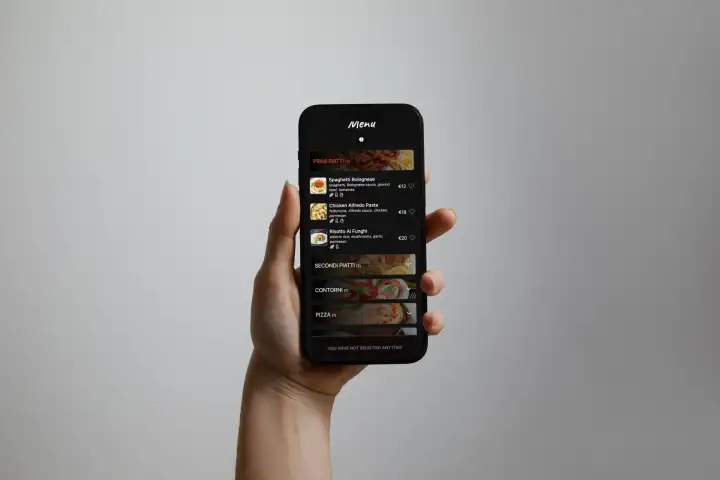
Price changes only help once guests see them. With Elegant Menu, the QR menu and ordering platform, you change a price online and every guest who scans sees it straight away, with nothing to reprint; the built-in menu assistant can apply a change to a whole group of dishes by chat, and you approve each change before it goes live. A dish whose contribution is too low can be hidden until you have re-costed it.
How do you check your real break-even number?
Your break-even number is right when a month in which you served about that many covers comes out close to zero profit in your accounts. Check it in three ways:
- Against the monthly profit and loss: take actual covers minus break-even covers and multiply by the contribution per cover. 1,000 covers in the trattoria example should give about (1,000 − 942) × €17 = €986 of profit. If the accounts show much less, a cost is missing or a variable cost is higher than you thought.
- Every week from the till: covers served and net sales per cover against your daily target. Count the days below break-even, not just the total.
- Your margin of safety: (actual covers − break-even covers) ÷ actual covers. At 1,100 covers a month the trattoria has a margin of safety of 14%: covers could drop by that much before it loses money.
Recalculate whenever rent, wages or VAT change, when you change opening days, and at least every quarter.
Common break-even mistakes
- Using sales including VAT. As the pizzeria example shows, it hides several covers a day.
- Dividing total costs by the average bill. This mixes fixed and variable costs and gives a figure that is only right at the volume you already do; it can’t tell you what happens when covers change.
- Counting staff at gross wages. Employer contributions, holiday pay and extra monthly salaries belong in the fixed costs.
- Leaving out the owner’s pay. A break-even that only works because you work unpaid is not a break-even.
- Using one month for a seasonal business. Calculate a quiet month and a busy month, and make sure the year as a whole clears the break-even.
FAQ: restaurant break-even point
How do you calculate a restaurant’s break-even point?
Divide your monthly fixed costs by the contribution per cover (net spend per guest minus variable cost per guest). €16,000 ÷ €17 = 942 covers a month.
How many covers does a restaurant need a day to break even?
Divide your monthly break-even covers by the days you are open; there is no general number. In the illustrative trattoria it is 942 ÷ 26 = 37 covers a day.
Is staff a fixed or a variable cost?
Staff on fixed contracts are a fixed cost, and hours you add or cut with the number of guests are variable. Count both at their full cost including employer contributions.
Should I calculate break-even with or without VAT?
Without VAT, because the VAT you collect is owed to the tax office. Remove it at the rate for each part of the bill, for example 7% on food and 19% on drinks in Germany.
How long does it take a new restaurant to break even?
There is no reliable average, so work it out for your own plan: first the month in which covers reach the monthly break-even, then the opening investment ÷ monthly profit after that for the months needed to earn the investment back.
Know your number, then move it
Once you know how many covers you need a day, every price and every rota decision has a clear target. Elegant Menu is free to start: put your menu on a QR code, take orders from the table, and change prices from your phone the moment your numbers say so.


Comments