Do Restaurants Have to Provide Allergen Information? The Rules by Country
Yes: in the EU, restaurants and cafés have to provide allergen information for every dish. What the law requires, written vs verbal rules by country, and simple ways to show it.
On this page
- What does EU law require for allergen information in restaurants?
- Is verbal allergen information enough, or does it have to be written?
- Allergen information rules by country
- What happens if you don't provide allergen information?
- What must your staff be able to answer?
- What is the simplest way to show food allergies on a café menu?
- How do you check your allergen information is right?
- Common allergen information mistakes
- FAQ: allergen information in restaurants
- Show allergens on every dish, and keep them current
Yes: in the EU, every restaurant, café, bar and hotel has to provide allergen information for the food it serves, telling guests which of the 14 allergens each dish contains. The rule comes from Article 44 of Regulation (EU) No 1169/2011, which makes allergen information mandatory for food sold without packaging. What differs between countries is how you give it: some require it in writing, others accept a verbal answer from staff backed by a visible notice and a written record.
Short answer: if you run a small café in Italy, Germany or Spain, you can meet the rule with a notice such as “Allergies? Ask our staff” plus a written allergen record for every item that staff and inspectors can see on request. In France and Norway, guests must be able to read the information in writing without relying on a conversation. Everywhere, the simplest safe option is the same: write the allergens next to each dish, and keep a written allergen sheet behind the counter.
The rule in three lines:
- Who: every business serving food that is not prepacked, including drinks, specials and takeaway counters.
- What: which of the 14 allergens each item contains, including those in sauces, sides and garnishes.
- How: in writing, unless your country allows verbal information with a visible notice and a written record behind it.
This article is practical guidance, not legal advice. Your local food authority has the final word.
What does EU law require for allergen information in restaurants?
EU law requires food businesses to tell guests about any of the 14 listed allergens used in food sold without packaging, and lets each country decide the means. Article 44(1)(a) says the allergen particulars are “mandatory” for foods offered to the final consumer or to mass caterers without prepackaging. Article 44(2) adds that member states “may adopt national measures concerning the means through which the particulars … are to be made available” (Regulation 1169/2011).
The European Commission’s 2017 notice on allergen information explains what that means in practice. Where a country has national measures, other means are possible, including “verbal communication (i.e. verifiable oral information)”. Where it has none, the information must be written, and “it is not possible to provide allergen information only upon request by the consumer”.
The 14 allergens are cereals containing gluten, crustaceans, eggs, fish, peanuts, soybeans, milk, nuts, celery, mustard, sesame, sulphites, lupin and molluscs. Our guide to the 14 allergens on your menu shows where each one hides and how to label it step by step, so this article focuses on what the law asks of you.
Is verbal allergen information enough, or does it have to be written?
Verbal allergen information is enough only in countries whose national rules allow it, and even there it must be backed by a written record and a visible notice. In practice, a “verbal” system has three parts:
- A visible notice on the menu, the counter or the wall telling guests to ask staff about allergens.
- A written or electronic record of the allergens in every item, kept on the premises.
- Access on request to that record for guests and food inspectors, before the guest orders.
So even where verbal information is legal, you still need the written allergen record. The only question is whether it has to be in front of the guest or can stay behind the counter.
Allergen information rules by country
The allergen list is the same in every country below, but the accepted way of showing it differs. Here is what each country’s law or food authority says, checked in November 2026:
| Country | Is verbal information enough? | What the rule says |
|---|---|---|
| Italy | Yes, with a notice and written documentation | Allergens on the menu, a register, a sign or an equivalent system, also digital; if digital, also in written documentation easy to find for guests and inspectors. A notice inviting guests to ask staff is allowed if the information is recorded in writing (D.Lgs. 231/2017, art. 19, as summarised by FIPE) |
| Germany | Yes, with conditions | On menus and drink lists, also as footnotes; or verbally if a written or electronic record exists, it is directly accessible on request, and a clearly visible notice says the information is given verbally (§ 4 LMIDV) |
| Spain | Yes, with conditions | Verbally if the information is recorded in writing or electronically on the premises, is accessible to staff, inspectors and guests, and a visible notice says where to find it or to ask staff (Real Decreto 126/2015, art. 6) |
| France | No | Guests must be informed in writing, legibly and visibly, either of the allergens themselves or of how the written information is made available, with direct and free access to it (Code de la consommation, art. R412-14; see justice.fr) |
| Norway (EEA) | No | Allergen information must be available in writing directly to the guest; talking to staff is “in addition to, not instead of” written information (Mattilsynet guide) |
| Turkey | Not confirmed | 2026 rules require ingredient information on menus, boards, screens or a QR code; if you use a QR code, you must tell guests who can’t use it that the information is available separately (Ministry of Agriculture and Forestry). News reports say allergens must also appear on menus (CNBC-e) |
| United Kingdom | Yes, with a written notice | Allergen information must be supplied for every item; it can be given verbally “with a written notice placed in a clearly visible position”. The FSA recommends written information supported by a conversation (FSA guidance, England, Wales and Northern Ireland) |
For Turkey, the official announcement we could open covers ingredient and calorie information but does not mention allergens; the allergen requirement there comes from news reports, so treat it as not confirmed by an official source we read.
What happens if you don’t provide allergen information?
You can be fined or ordered to fix it, but confirmed fine amounts were only published for some of the countries we checked. Italy is the clearest case, with fines set in D.Lgs. 231/2017 (as listed by FIPE):
| Italy: what went wrong | Fine |
|---|---|
| Allergen information not given at all | €3,000 to €24,000 |
| Information given in the wrong form or way | €1,000 to €8,000 |
| Purely formal defects | €500 to €4,000 |
In the UK, local authorities enforce the rules and can issue an improvement notice, with a penalty if it is not met (FSA). For Germany, Spain, France, Norway and Turkey, the official sources we opened did not state fine amounts, so we don’t give one here.
What must your staff be able to answer?
Staff must be able to tell a guest, before they order, which of the 14 allergens a dish contains, using the written record rather than memory. German rules, for example, allow verbal information only from staff who are “sufficiently informed” (§ 4 LMIDV). A short routine works in any country:
- Show every new team member where the allergen sheet is, on their first shift.
- When a guest mentions an allergy, read the answer from the sheet, not from memory.
- If a dish is not on the sheet (a special, a swapped ingredient), ask the kitchen before answering.
- Never say “it should be fine”. If you can’t confirm, say so and suggest another dish.
What is the simplest way to show food allergies on a café menu?
The simplest way is one of three formats: an allergen column on the menu, symbols with a key, or a notice plus a written allergen matrix. Pick the one your country accepts and your menu can carry.
| Option | What guests see | Works where | Watch out for |
|---|---|---|---|
| Allergen column or line per dish | “Contains: milk, wheat” under each item | Everywhere | Long menus get crowded |
| Symbols or letter codes with a key | Icons or A, G, L next to each item, with a legend on the same page | Everywhere, if the key is visible | Codes mean nothing without the key |
| Notice plus written allergen matrix | “Allergies? Ask our staff” and a sheet behind the counter | Countries that allow verbal information (e.g. Italy, Germany, Spain, UK) | Not enough on its own in France or Norway |
Here is how a short café menu could look with the first option. This is an illustrative example, not real product data: always check your own recipes and supplier labels.
| Item | Price | Allergens (example) |
|---|---|---|
| Espresso | €1.50 | None |
| Cappuccino | €2.80 | Milk |
| Butter croissant | €2.20 | Wheat, milk, eggs |
| Ham and cheese toastie | €6.50 | Wheat, milk, mustard |
| Pesto pasta salad | €8.90 | Wheat, milk, nuts (cashew) |
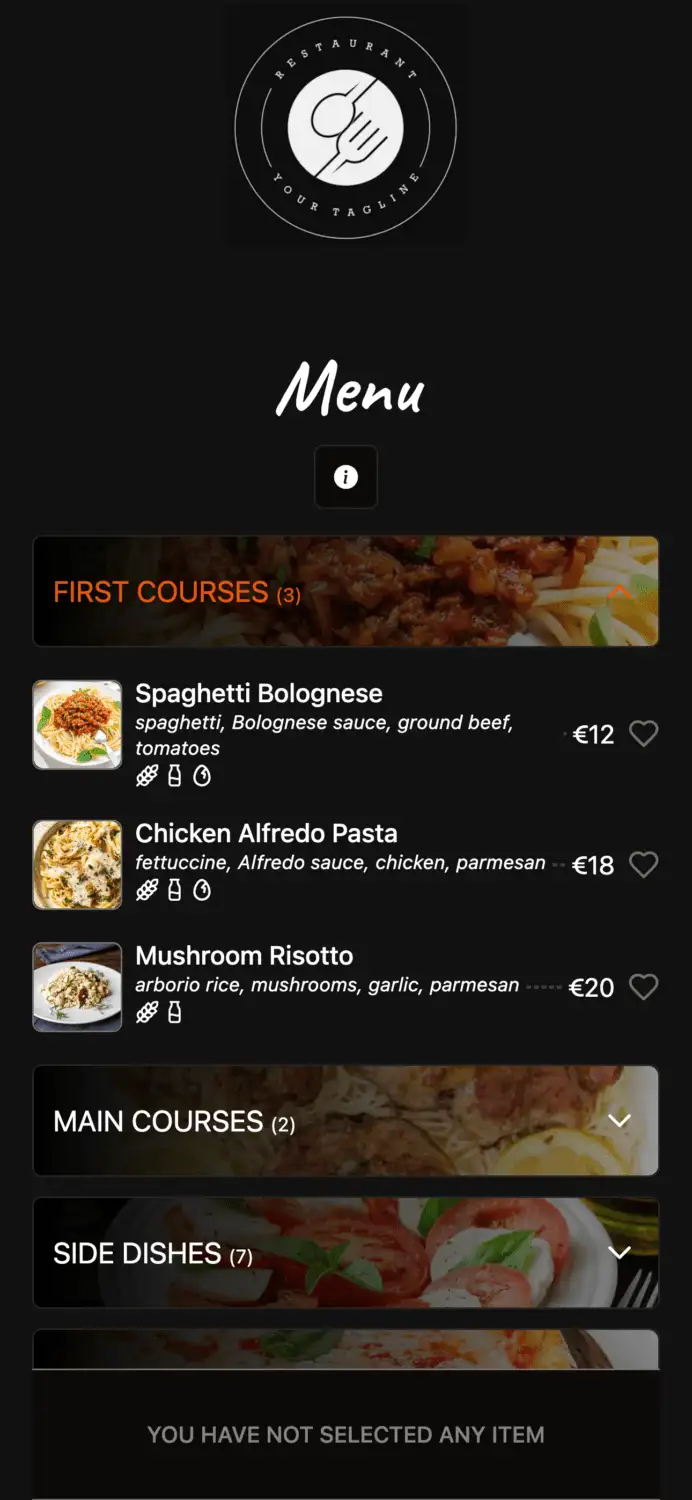
The hard part is keeping it true when a supplier or recipe changes. In Elegant Menu, the QR menu and ordering platform, you can tag each dish with any of the 14 EU allergens, and guests see them as icons on the dish. When the pesto supplier changes, you edit the dish from your phone and the menu updates without a reprint. You still decide which allergens each dish contains, so the menu is only as accurate as what you enter. In France and Italy, also keep a written allergen sheet on the premises, as the rules above require.
If you already keep recipe cards for costing, as in our guide to recipe costing, add an allergen column to the same card: the ingredient list is already there. The same cards feed your prices too; see how to price menu items. Serving tourists? Translate allergen names along with the dishes (how to translate your restaurant menu).
How do you check your allergen information is right?
Check it by picking three random dishes each month and comparing the menu, the allergen sheet and the actual supplier labels in the kitchen. Ask three questions for each dish:
- Do the menu and the allergen sheet list the same allergens?
- Do the supplier labels of every component (sauce, bread, garnish) match the sheet?
- Could a new staff member find the answer in under a minute?
If one dish fails, the same mistake is probably elsewhere: check the whole menu. Repeat after every menu change and every supplier change.
Common allergen information mistakes
The most common mistakes are relying on staff memory, forgetting components and letting the information go out of date.
- “Ask staff” with nothing written behind it. Every country above that allows verbal information also requires a written or electronic record.
- A blanket “may contain allergens” line. It doesn’t tell a guest which allergens are in which dish.
- Forgetting sauces, sides and drinks. Milk in coffee drinks, sulphites in wine and barley in beer count too.
- Specials with no allergen information. The chalkboard dish needs it as much as the printed menu.
- A QR code as the only source with no alternative. In Turkey you must tell guests the information is available another way; in Italy digital information also needs written documentation.
FAQ: allergen information in restaurants
Do restaurants have to provide allergen information?
Yes, in the EU and the UK every food business must provide information on the 14 allergens in the food it serves. Countries differ only on whether it must be written or can be given verbally with a notice and a written record.
Do allergens have to be printed on the menu?
Not in every country: Italy, Germany, Spain and the UK also accept a visible notice plus a written record available on request. France and Norway require written information guests can access directly.
Does the law require a digital menu for allergens?
No, none of the rules we checked require a digital menu; paper menus, signs and allergen sheets are all accepted. A digital menu is allowed in most countries but may need a written backup, as in Italy.
Do small cafés have to follow the same rules?
Yes, the allergen rules apply to any business serving non-prepacked food, whatever its size. Italy reduces fines for micro-enterprises but does not exempt them.
Do drinks need allergen information?
Yes, drinks served without packaging are covered like food: milk in coffee drinks, sulphites in wine and cereals in beer must be declared. See our 14 allergens guide for the exemptions.
Show allergens on every dish, and keep them current
Build a free digital menu with Elegant Menu, tag the 14 allergens on each dish and update them the day a recipe changes. See how a live menu looks on a guest’s phone first.


Comments